Artificial intelligence versus traditional approaches in multicomponent spectral analysis
- Publish Date: 1 - March - 2026
Research Abstract:
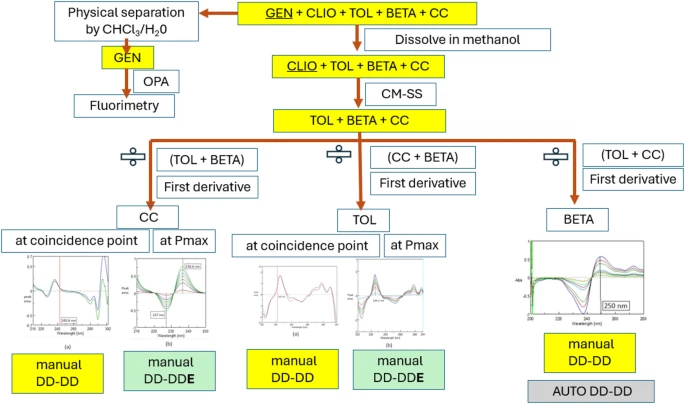
This study explores the use of AI-assisted data handlingin spectrophotometric method development, providing a flexible and globally accessible alternative to traditional manual software algorithms.Quadriderm cream combines four active ingredients: Clioquinol (CLIO), Betamethasone (BETA), Tolnaftate (TOL), and Gentamicin (GEN) with the preservative Chlorocresol (CC). Building on our previous research on complex pharmaceutical mixtures with challenging ratios, this study applied established protocols for CLIO and GEN while focusing on the more analytically demanding ternary subsystem (TOL, BETA, and CC).The integration of AI-enhanced spectral handling and interpretation reduces operator-dependent variability and streamlines the analytical workflow. This includes generating calibration graphs and regression equations, as well as effectively handling scanned spectral data via consecutive prompts. Validation data such as accuracy and precision are assessed to ensure reliability. Furthermore, the system enables intelligent, simultaneous analysis of laboratory mixtures and pharmaceutical formulations, enhancing both efficiency and accuracy. The AI strategy, trained on spectral data supplied and monitored by the expertiseanalyst, can automatically predict optimal wavelengths with minimal interference, while manual handling strategy rely on analyst-driven selection. Two novel approaches were developed: the factorized derivative ratio extraction using double divisor (MAN-[DD- DDE])via Spectra Manager® software and the automated double divisor derivative ratio (AUTO-[DD-DD]) via AI tools and for resolving ternary mixtures with severely overlapping UV spectra and comparing the results with those of(MAN-[DD- DD])at coincidence points. Linear working ranges were 0.5–5.0 µg/mL (TOL), 3.0–30.0 µg/mL (BETA), and 2.0–20.0 µg/mL (CC); LODs were 0.09, 0.09, and 0.26 µg/mL, respectively. AI-driven data processing strategy matched the accuracy and reproducibility of traditional strategy manipulation while reducing subjective steps and effort. Finally, the UV-spectrophotometric method for pharmaceutical cream analysis was evaluated using the MA Tool (2025) to assess sustainability across green, white, and AI-driven criteria. AI-assisted scoring via Microsoft Copilot enabled rapid, reproducible assessment, yielding a Whiteness Score of 60.9% and providing actionable recommendations for greener and more efficient workflows
Publishers: